
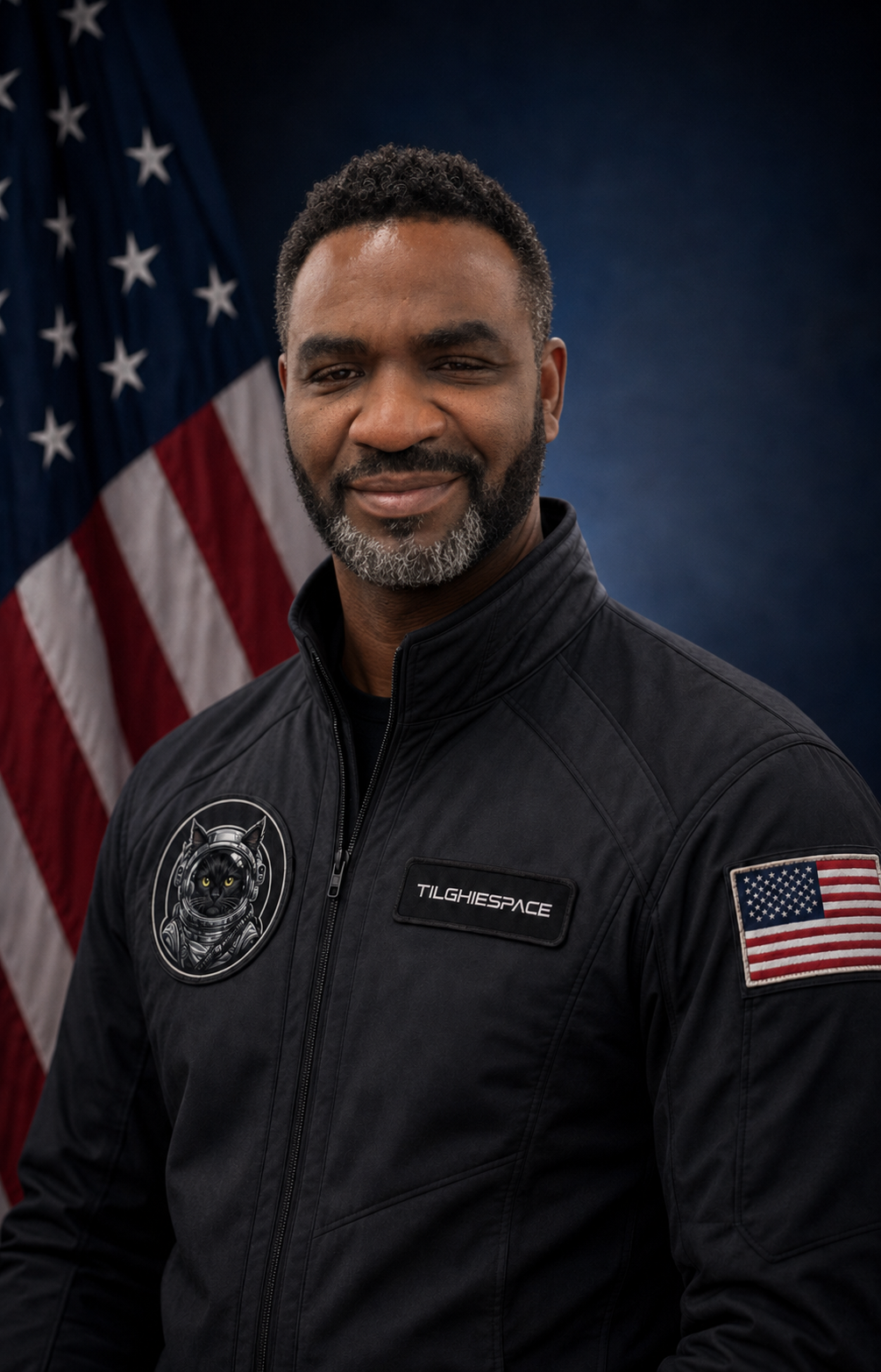
A long-form biography connecting commercial real estate, energy innovation, OMER-III, TilghieSpace, artistic philosophy, and long-term infrastructure vision.
Use: Definitive founder biography for institutional publications, master plans, data room background materials, website long-form profile, and strategic partner context.
Opening Narrative
Michael R. Tilghman Jr.'s career has been defined by a persistent question: what happens when infrastructure is treated not as a fixed physical object, but as a living system of energy, finance, design, technology, and human purpose? That question has followed him from commercial real estate into energy innovation, from building operations into advanced power systems, from institutional acquisition strategies into the development of OMER-III, and from abstract expressionist art into a broader philosophy about physics, entropy, civilization, and the future of human expansion.
His story does not begin inside a conventional technology laboratory. It begins in the world of buildings, assets, tenants, utilities, capital budgets, maintenance systems, and the daily reality of operating large pieces of the built environment. Commercial real estate gave him a practical education in how civilization actually functions. Buildings are not only structures. They are energy-consuming organisms. They are financial instruments. They are social containers. They are dependent on grids, utilities, labor, materials, insurance, regulation, and long-term capital.
Over time, Mr. Tilghman came to see that the deepest limitation inside real estate was not simply design or location. It was energy dependence. A building can be architecturally significant, financially attractive, and strategically located, yet still remain vulnerable because it depends on external power systems it does not control. That recognition became the bridge between his real estate career and his later work in advanced energy.
Commercial Real Estate as the First Laboratory
For more than three decades, Mr. Tilghman worked across commercial real estate development, investment analysis, property management, and institutional acquisitions. His experience included evaluating, managing, and developing complex commercial assets totaling millions of square feet and portfolios exceeding one hundred million dollars in value. This period gave him a rigorous, practical understanding of how major assets are underwritten, operated, improved, and repositioned.
Real estate forced a discipline that would later influence his approach to technology. A building cannot be managed through theory alone. It must work every day. Its mechanical systems must run. Its tenants must be served. Its operating expenses must be controlled. Its risks must be insured. Its capital improvements must be justified. Its financing must make sense. Its legal, utility, environmental, and maintenance records must be understood. This practical environment became Mr. Tilghman's first systems laboratory.
Through property management and acquisition work, he learned to read assets as layered systems. A landmark office building might appear to be a single object, but in practice it is a convergence of leases, elevators, boilers, chillers, electrical rooms, maintenance logs, municipal approvals, tax positions, tenant expectations, financing assumptions, historical constraints, and market psychology. To understand value, one must understand the whole system.
That habit of whole-system thinking later became central to his energy work. The same mind that studies a commercial asset through operating statements, physical condition, utility usage, and redevelopment potential can also study an energy platform through fuel cycles, confinement systems, conversion pathways, manufacturing readiness, capital staging, and market deployment. The subject changed, but the method remained consistent.
Institutional Acquisition Experience and Value Discipline
Mr. Tilghman's commercial real estate career included institutional acquisition strategies involving landmark office towers and mixed-use properties in Chicago, Manhattan, San Francisco, Los Angeles, Philadelphia, and other major metropolitan markets. These markets sharpened his understanding of how institutional capital evaluates location, scale, risk, timing, and long-term value creation.
Major-market acquisition work requires more than enthusiasm for an asset. It requires discipline. A buyer must understand why an asset is mispriced, underutilized, overburdened, or strategically important. A manager must understand how operating changes affect value. A developer must understand how capital improvements, tenant repositioning, and infrastructure upgrades alter long-term outcomes. Mr. Tilghman's experience across these environments gave him a grounded appreciation for how capital-intensive projects must be structured.
This background matters because advanced energy and space infrastructure also require institutional discipline. They are not merely inventions. They must become financeable platforms. They require governance, milestones, technical evidence, counterparties, facility strategy, intellectual property protection, regulatory awareness, and the ability to communicate risk honestly. Mr. Tilghman's real estate foundation trained him to think in those terms long before he entered the advanced energy arena.
The Energy Problem Inside Buildings
Beginning in the early 2000s, Mr. Tilghman recognized that the future of commercial real estate would be defined by energy independence as much as by architecture or finance. Rising utility costs, grid vulnerability, climate concerns, and the growing importance of resilient infrastructure changed the way he viewed the built environment.
He began to see buildings not simply as consumers of energy, but as potential participants in energy production and distribution. If a building could generate part of its own power, reduce dependence on centralized grids, and improve operating stability, then energy would become a value driver rather than only a cost center. This insight led him toward an integrated view of real estate and energy technology.
That recognition eventually led him to establish Tilghman Atlantic as an integrated real estate and energy development company. The company was dedicated to rethinking how buildings generate, consume, and distribute energy. Its work expanded beyond conventional sustainability into a published U.S. patent application for a building-integrated energy system and new concepts for decentralized infrastructure.
For Mr. Tilghman, sustainability was never only about public image or compliance. It was about control, resilience, economics, and technological evolution. A building that produces energy has a different strategic character than a building that simply buys energy. A city that can generate resilient power has a different future than a city fully dependent on fragile external systems. This line of thinking became one of the intellectual foundations for his later work in fusion and space power.
Kaiserman, the Green Council, and Historic-Building Energy Integration
During his tenure with Kaiserman Management Company, Mr. Tilghman led commercial property management and acquisition initiatives while also serving as Chairman of the company's Green Council. In that role, he directed energy-efficiency initiatives for numerous historic and institutional properties, including the nationally recognized Philadelphia Bourse Building.
The Philadelphia Bourse project was especially meaningful because historic buildings present a complex test case for energy innovation. They are architecturally significant, operationally demanding, and often constrained by preservation requirements. Introducing energy improvements into such assets requires careful coordination among building systems, ownership objectives, regulatory considerations, tenant needs, and long-term property value.
Mr. Tilghman helped oversee one of the region's notable historic-building solar integration projects. That experience reinforced his belief that innovation must be made practical inside real assets. A concept that cannot be installed, permitted, maintained, financed, or operated will not change the world. Energy technology must eventually meet the discipline of the built environment.
This became a recurring theme in his work: advanced ideas must be translated into infrastructure. The bridge between concept and deployment is not automatic. It requires institutional planning, technical detail, documentation, counterparties, facility readiness, and the willingness to solve practical problems that may appear less glamorous than the original idea but are essential to execution.
From Efficiency to Energy Independence
As his work evolved, Mr. Tilghman moved from energy efficiency toward the larger question of energy independence. Efficiency is important, but it does not fully solve dependence. A more efficient building still relies on the grid. A more efficient city may still be vulnerable to outages, price shocks, and supply constraints. A more efficient industrial economy may still be limited by the density, reliability, and strategic control of its power sources.
This shift in thinking moved him toward more fundamental energy questions. What would it mean for infrastructure to have access to high-density, clean, distributed power? What would it mean for energy production to be modular, resilient, and less dependent on fuel logistics? What would it mean for buildings, industrial centers, ports, defense facilities, and space platforms to control their own energy destiny?
The logic of commercial real estate had pushed him toward energy. The logic of energy pushed him toward fusion. Fusion represented not simply a scientific ambition, but a possible redefinition of infrastructure itself. If energy could be produced cleanly, densely, and reliably, then the economics of real estate, industry, transportation, national security, and space operations could change.
Documented Energy Innovation and PPPL Engagement, 2014-2015
The transition from building systems to advanced energy was documented in Mr. Tilghman's own intellectual-property work. U.S. Patent Application Publication No. US20140202154A1, published in July 2014 and naming him as inventor, described an integrated renewable-energy system combining building-based solar, wind, hydrogen production, energy storage, and fuel-cell technologies. The application did not issue as a patent, but its publication provides a dated record of the systems approach that preceded his fusion work.
By December 2014, that work had developed into a substantive engagement with the Princeton Plasma Physics Laboratory. A December 8 meeting at the PPPL campus addressed commercialization objectives, staged field-reversed-configuration development, potential funding requirements, prototype planning, intellectual property, and the steps needed to translate a laboratory program toward clean-energy applications.
Tilghman Atlantic and the Trustees of Princeton University, acting through PPPL, subsequently executed a non-binding memorandum of understanding to explore a possible research collaboration involving a staged series of field-reversed-configuration fusion plasma devices. PPPL Director Dr. Stewart Prager signed the MOU on December 18, 2014, and Mr. Tilghman signed it on December 22, completing the document. The MOU contemplated a separately funded and DOE-reviewed Work for Others agreement as the binding framework that would be required before research commenced.
The engagement proceeded far enough for PPPL's Work for Others model agreement to be placed into the development record and for a detailed draft Princeton technology option and licensing framework to be prepared covering several FRC-related technologies. Those documents demonstrate that the effort had moved beyond a general expression of interest into discussion of funding, research structure, intellectual property, and potential commercialization, even though the WFO agreement and technology option were not executed in the records reviewed.
In February 2015, Tilghman Atlantic also entered into a signed, non-binding $40 million equity investment term sheet intended to support execution of the contemplated PPPL work and an advanced-energy prototype-development program. The available records do not establish that the financing closed. They do, however, establish a multi-step effort involving laboratory engagement, an executed MOU, a contemplated sponsored-research structure, an intellectual-property pathway, and a serious capital-formation initiative. That documented history is part of the foundation from which the OMER-III program has continued to develop for more than a decade.
The Birth of OMER-III
OMER-III, the Oceanic Mass Energy Reactor III, emerged from this long arc of inquiry. Mr. Tilghman developed OMER-III as a privately developed advanced energy platform based upon field-reversed configuration plasma confinement, advanced direct charged-particle energy conversion, and modular distributed power generation.
The concept reflects his interest in aneutronic fusion pathways and the possibility of systems that can convert charged-particle energy more directly into usable electricity. It also reflects his infrastructure background. OMER-III is not framed only as a scientific device. It is framed as a platform that must eventually be evaluated through development gates, evidence packages, technical review, manufacturing readiness, capital requirements, deployment pathways, and institutional governance.
Mr. Tilghman's long-term objective is to create commercially deployable fusion systems capable of producing carbon-free electricity for terrestrial infrastructure, sovereign energy independence, industrial applications, and future space operations. That objective is ambitious, but it is also continuous with the questions that began in his real estate career: how does infrastructure become more independent, productive, resilient, and valuable?
He understands that advanced energy systems require patience, evidence, and disciplined development. The path from concept to commercialization is not a matter of assertion. It requires simulation, engineering, validation, third-party review, facility planning, intellectual property protection, manufacturing strategy, regulatory awareness, and milestone-based capitalization. In that sense, OMER-III is not only a technical project. It is an institutional development project.
TilghmanKraftwerk
TilghmanKraftwerk was founded to focus on advanced energy systems and sovereign infrastructure deployment. The company expresses the terrestrial side of Mr. Tilghman's energy thesis: advanced power generation should serve cities, industrial assets, real estate portfolios, critical infrastructure, and public-sector resilience.
The company's work is rooted in the belief that energy infrastructure will increasingly determine economic sovereignty. Nations, states, cities, ports, industrial centers, and major property systems require dependable power. As electrification expands and infrastructure becomes more digital, power is no longer a background utility. It is a strategic resource.
TilghmanKraftwerk connects Mr. Tilghman's earlier real estate and energy work to his advanced energy ambitions. It recognizes that any breakthrough energy platform must eventually live somewhere, connect to facilities, serve users, meet safety expectations, satisfy investors, and support long-term operations. The company therefore represents both a technology vision and an infrastructure deployment frame.
TilghieSpace
TilghieSpace was founded to apply advanced fusion technologies to orbital power systems, spacecraft propulsion, and future space industrialization. It represents the space-facing extension of the same energy thesis: high-density power is a foundation for human activity beyond Earth.
Space infrastructure is ultimately constrained by energy. Satellites, stations, propulsion systems, orbital manufacturing platforms, lunar infrastructure, and deep-space missions all require power. The more ambitious the mission, the more central energy becomes. Mr. Tilghman views advanced power generation as one of the enabling conditions for a durable space economy.
TilghieSpace connects orbital power, propulsion, and industrial development to the broader commercialization of OMER-III. It is not separate from his terrestrial infrastructure work. It is an extension of it. The same power-density, resilience, and independence questions that matter to cities and industrial assets also matter in orbit, on the Moon, and in future space operating environments.
Art, Physics, and the Language of Systems
Mr. Tilghman is also an accomplished abstract expressionist artist whose work explores the intersection of physics, entropy, cosmology, engineering, and human civilization. His artistic practice is not a side note to his technical work. It is one of the ways he thinks.
Rather than viewing art and science as separate disciplines, he considers them complementary methods of discovery. Scientific inquiry seeks structure, law, and explanation. Art explores pattern, feeling, emergence, disorder, and symbolic meaning. For Mr. Tilghman, both are attempts to understand reality at different levels of resolution.
His paintings frequently translate scientific concepts into visual form. They draw from ideas related to entropy, energy, cosmology, motion, structure, and transformation. His artwork has historically been used to support research initiatives and communicate complex scientific ideas to broader audiences.
This artistic dimension informs his leadership philosophy. Breakthrough ideas often require the ability to see across categories before the categories are formally connected. Art trains perception. Engineering disciplines imagination. Finance imposes consequence. Infrastructure demands endurance. Mr. Tilghman's work exists in the tension among those forces.
Self-Directed Scientific Education and Independent Research
Throughout his career, Mr. Tilghman has remained largely self-directed in his scientific education. He has pursued advanced study in thermodynamics, nuclear physics, energy systems, and related disciplines while building practical expertise through independent research and engineering development.
This path has been unconventional. It has required persistence, intellectual humility, and the willingness to build a knowledge base outside traditional institutional channels. It also reflects his broader belief that complex global challenges cannot always be solved by staying inside established professional lanes.
His multidisciplinary approach combines entrepreneurial execution, institutional finance, engineering, architecture, and scientific inquiry. That combination shapes the way he approaches OMER-III and TilghieSpace. He is interested not only in whether a technical concept is elegant, but whether it can be governed, financed, manufactured, documented, tested, and ultimately deployed.
This is why his founder story is inseparable from institutional readiness. A large technical vision must be translated into a form that investors, agencies, advisors, engineers, manufacturers, insurers, and strategic partners can evaluate. Mr. Tilghman's work increasingly focuses on making that translation possible.
Capitalization, Governance, and Institutional Readiness
Mr. Tilghman's current stage of work is centered on institutional capitalization. Advanced energy and space infrastructure cannot be built through inspiration alone. They require capital structures, governance systems, technical diligence, evidence development, intellectual property strategy, facility planning, and clear communication with stakeholders.
His investor-facing work seeks to organize OMER-III, TilghmanKraftwerk, and TilghieSpace into formats that can be reviewed by private equity firms, sovereign wealth funds, public agencies, strategic industrial partners, and major foundations. The objective is to make the vision legible to institutional audiences without diminishing its scale.
This means separating inspiration from execution. The founder's role is to hold the long-term vision. Technical advisors and engineering teams must validate the science and implementation pathways. Commercial advisors must test markets and revenue models. Governance structures must protect credibility. Capital plans must stage risk responsibly. The company must mature from a founder-led concept into an institutionally governable platform.
The Built Environment as an Energy System
One of the most important through-lines in Mr. Tilghman's work is the idea that the built environment is already an energy system, whether or not owners describe it that way. Every office tower, industrial facility, hotel, residential complex, port, airport, laboratory, and data center is organized around energy flows. Electricity powers equipment. Thermal systems regulate human occupancy. Mechanical rooms define operating limits. Utility costs influence net operating income. Backup power determines resilience. Grid reliability affects business continuity.
Commercial real estate taught him that energy is embedded in value. A property's apparent financial performance can change when energy costs rise, when equipment fails, when grid service becomes unreliable, or when tenants begin demanding more resilient systems. Energy is therefore not peripheral to asset management. It is one of the hidden structures beneath asset performance.
This insight helped move Mr. Tilghman beyond incremental conservation. Efficiency upgrades were useful, but they did not answer the deeper question. If infrastructure remains dependent on external energy systems that are centralized, aging, vulnerable, or politically constrained, then the asset remains exposed. A truly strategic infrastructure thesis must ask how power is produced, where it is produced, how it is distributed, how failure is managed, and how energy independence changes the economics of ownership.
In this sense, his move toward advanced energy was not a departure from real estate. It was an extension of real estate thinking into the source layer of civilization's operating system. The building led to the utility room. The utility room led to the grid. The grid led to generation. Generation led to fusion. Fusion led to the question of whether energy could become abundant enough to change both terrestrial infrastructure and the future of space operations.
Why Space Is an Infrastructure Problem
Mr. Tilghman's interest in space is not based only on exploration. It is based on infrastructure. Space activity cannot mature into a durable economy unless it has reliable power, repeatable logistics, capable propulsion, manufacturing capacity, data systems, and governed platforms that can support long-duration operations. In that respect, the space economy faces many of the same questions as terrestrial infrastructure, but under harsher constraints.
A city requires power to function. An orbital platform requires power to exist. A commercial building must manage heat, structure, safety, maintenance, and operating cost. A spacecraft or orbital facility must manage energy, thermal loads, propulsion limits, materials, autonomy, radiation exposure, and mission reliability. The differences are profound, but the systems logic is familiar to someone trained to see infrastructure as a set of interacting dependencies.
TilghieSpace reflects Mr. Tilghman's belief that advanced energy may become one of the decisive foundations of space industrialization. Solar power, batteries, chemical propulsion, and existing nuclear systems each have roles, but the long-term expansion of orbital manufacturing, high-energy propulsion, lunar operations, and deep-space industrial activity may require new power-density pathways. OMER-III is therefore framed not only as a terrestrial energy platform, but also as a possible contributor to future space operating architectures.
This space thesis is connected to his work in commercial real estate more directly than it may first appear. In both domains, value depends on the capacity to operate complex systems over time. Both require capital planning, technical reliability, maintenance logic, governance, risk management, and the conversion of physical capability into economic use. Mr. Tilghman's founder narrative links Earth-based infrastructure and space infrastructure through the common language of energy, systems, and long-term institutional development.
Founder Operating Principles
Several operating principles recur throughout Mr. Tilghman's work. The first is that physical reality matters. Ideas must eventually meet buildings, equipment, utilities, documents, permits, budgets, counterparties, and operating conditions. A technology that cannot be translated into a deployable system remains incomplete, no matter how imaginative the original concept may be.
The second principle is that capital requires structure. Institutional investors and public-sector partners must be able to understand what is being built, what evidence supports it, which milestones reduce risk, which advisors are accountable, which assumptions remain open, and how capital will be used. Mr. Tilghman's current institutional work reflects the need to convert a large founder vision into diligence-ready materials.
The third principle is that disciplines should inform one another. Real estate teaches patience and operating discipline. Engineering teaches constraint. Finance teaches consequence. Art teaches perception and pattern recognition. Science teaches law, uncertainty, and experiment. Infrastructure teaches endurance. Mr. Tilghman's unusual career path has led him to treat these disciplines as complementary rather than separate.
The fourth principle is persistence. Large infrastructure ideas often require long gestation periods. They move through skepticism, partial evidence, incomplete resources, technical revisions, financing challenges, and the repeated need to explain the same idea to different audiences. Mr. Tilghman's work has required the willingness to remain with a problem long enough for its deeper structure to become visible.
The Translation Problem: From Vision to Institution
A central challenge in Mr. Tilghman's present work is translation. The founder's inner model may connect commercial real estate, energy systems, fusion physics, orbital infrastructure, and artistic philosophy in one continuous arc. Institutional audiences, however, require that arc to be separated into documents, claims, milestones, budgets, risks, governance structures, exhibits, and diligence workstreams.
This translation problem is not merely a communications exercise. It is a maturation process. A founder-led idea becomes institutionally credible when it can be inspected from multiple angles. Technical reviewers must see the scientific assumptions. Investors must see the capital plan and market logic. Government audiences must see strategic relevance and compliance awareness. Manufacturing partners must see facility requirements and process discipline. Counsel must see intellectual property, risk, and governance structures. Advisors must see where their expertise fits.
Mr. Tilghman's biography is therefore part of the institutional package. It explains why the founder is able to hold the integrated thesis. It shows how the real estate background led to energy independence, how energy independence led to fusion, how fusion led to space power, and how artistic and scientific thinking shaped the conceptual method. Without that biographical continuity, the current platform might appear disconnected. With it, the platform becomes the next stage of a long-running systems thesis.
The goal is not to make the biography a substitute for technical evidence. The goal is to show institutional readers that the founder's vision has a history, a logic, and a pattern of disciplined engagement with physical assets, energy systems, and long-term infrastructure problems. That context gives investors and partners a better way to understand the origin of the work and the founder's role in advancing it.
Definitive Biographical Positioning
The definitive version of Mr. Tilghman's biography should be understood as the story of convergence. Commercial real estate gave him the field experience to understand assets, operations, capital, and infrastructure. Energy innovation gave him the path toward independence, resilience, and decentralized power. OMER-III gave him the technical focus for a more fundamental energy platform. TilghmanKraftwerk gave him the terrestrial deployment frame. TilghieSpace gave him the orbital and space industrialization frame. Art gave him a language for complexity, entropy, and transformation.
This convergence is what makes the founder narrative different from a conventional executive biography. It is not organized around a single corporate title or a linear resume. It is organized around the development of a thesis: civilization's future depends on its ability to produce and govern advanced energy systems at infrastructure scale.
For private capital, the relevance is that Mr. Tilghman's work is tied to asset value, energy markets, infrastructure deployment, and long-horizon capitalization. For government agencies, the relevance is energy independence, industrial capability, resilience, and strategic technology development. For space-sector audiences, the relevance is power density, propulsion potential, orbital infrastructure, and the energy needs of future space operations. For major foundations and mission-driven institutions, the relevance is the possibility of cleaner energy systems and durable infrastructure for future generations.
The biography should therefore support a broad but disciplined identity: Mr. Tilghman is a founder working at the intersection of commercial real estate, advanced energy, sovereign infrastructure, and space industrialization. His story is ambitious because the problems he is addressing are large. It is institutional because the solutions must be financed, governed, validated, and deployed. It is personal because the work has grown out of decades of observation, persistence, self-directed study, creative production, and the conviction that energy is the central lever of civilization's next era.
Long-Term Vision
Mr. Tilghman's long-term mission is to develop technologies that fundamentally redefine how humanity generates energy, powers cities, expands into space, and builds sustainable infrastructure for future generations. His work is animated by the belief that energy is the central constraint on civilization's next stage.
If energy remains scarce, dirty, fragile, or geopolitically constrained, then the future narrows. If energy becomes clean, dense, resilient, and widely deployable, then the future expands. Cities can become more independent. Industrial systems can become more competitive. Nations can strengthen energy sovereignty. Space operations can move beyond fragile logistics and limited-duration missions.
The arc of Mr. Tilghman's career points toward this conclusion. Commercial real estate taught him how infrastructure works. Energy systems taught him where infrastructure is vulnerable. Fusion taught him to think at the level of civilization-scale power. TilghmanKraftwerk and TilghieSpace represent his attempt to organize that thinking into companies, platforms, and institutional development pathways.
Known for persistence, intellectual curiosity, and an unconventional approach to problem-solving, Mr. Tilghman believes transformative innovation occurs at the intersection of disciplines rather than within them. His life and work continue to move across those intersections: real estate and energy, finance and physics, art and engineering, Earth and space. The continuity is the point. His biography is not a set of unrelated chapters. It is one long effort to understand how humanity can build better systems of power, infrastructure, and possibility.